GP practices and PCNs
Significant events, complaints, audit cycles, governance meetings, CQC framework evidence — managed end-to-end rather than spread across a SharePoint site that nobody owns.
01.1 — Cadence
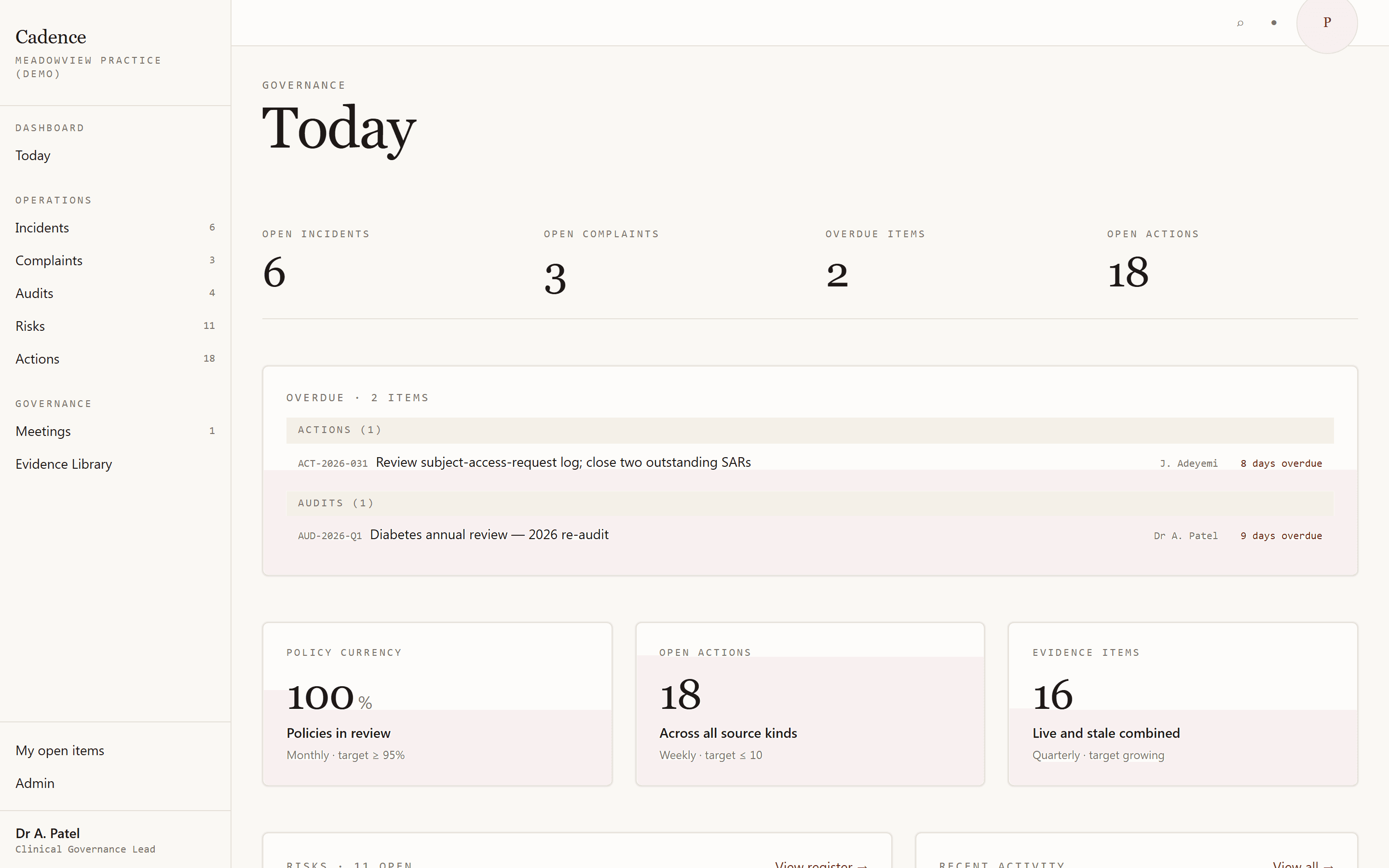
Cadence runs the cadence of governance work — risks, significant events, complaints, audits, decisions, and CQC-aligned evidence — as one connected operating system. Built for clinical governance leads who want to lead, not chase.
A — Who Cadence is for
Cadence is calibrated for the person whose desk every governance item lands on. The clinical governance lead at a GP practice or PCN. The registered manager at a care home. The medical director at a private clinic. People with judgement, time pressure, and a week that always has more items than working hours.
Significant events, complaints, audit cycles, governance meetings, CQC framework evidence — managed end-to-end rather than spread across a SharePoint site that nobody owns.
CQC-aligned evidence library, incident and safeguarding workflows, risk register tied to controls, audit cycles closed properly. Suitable for single homes through to multi-site groups.
Independent practices and dental service organisations needing structured clinical governance distinct from the NHS workflows their staff may be used to.
B — How it works
Cadence is organised around four working principles. Each pillar maps to specific modules; every module reinforces at least two of the four.
01
Significant events, complaints, audits, and incidents land in a single intake. One form, one queue, one source of truth — replacing the email-and-spreadsheet pattern that loses items between weekly meetings.
02
Each item is categorised, scored, and routed to the right register or owner. Cadence carries the schema; the governance lead carries the judgement. The result is fewer items left as 'someone should look at this'.
03
Governance meetings produce named decisions and dated actions, not minutes. Each decision references the specific items that drove it. Each action carries an owner, a due date, and a follow-through test.
04
Decisions update the risk register, policy library, and SOPs. Actions are tracked to closure. The next governance meeting opens with last meeting's actions, not from a blank page.
C — Modules
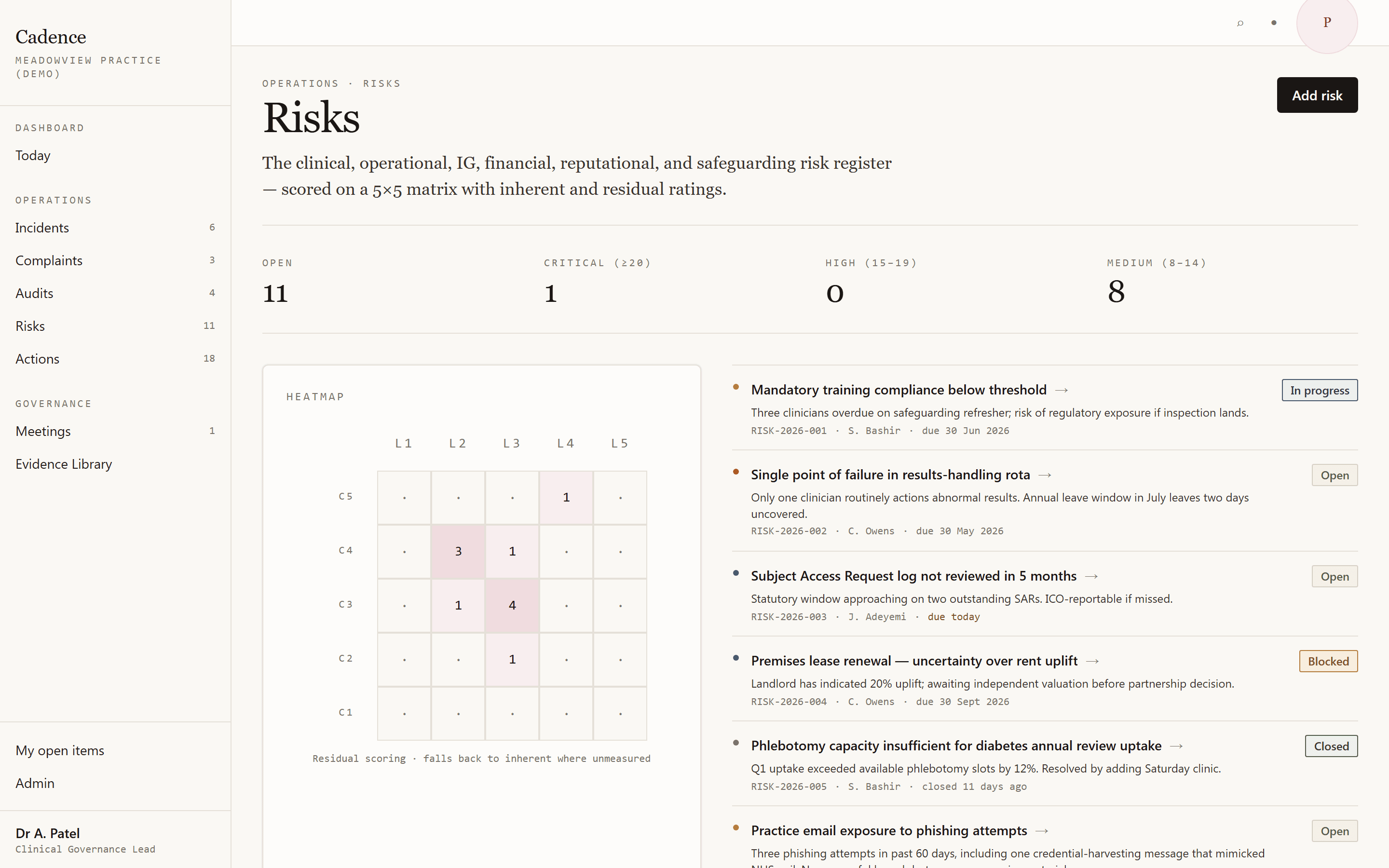
Each module addresses one governance domain. They share a common spine — actions, evidence, decisions — so an item flowing from incident to audit to policy never falls through the cracks between systems.
Significant events with severity scoring, root-cause analysis, and learning capture.
Complaint handling with the response timeline, the substantive position, the changed practice, and the closure record.
Audit cycles with standards, findings, action plans, re-audit, and impact measurement.
Risk register with likelihood × impact scoring, controls, owners, and review cadence.
Every action across every register, with owners, due dates, and closure tests.
Governance meeting agenda → decisions → action items, threaded through Cadence.
CQC-aligned evidence repository — every artefact tagged to the framework it supports.
Policy library with currency tracking, review cycles, and version history.
D — Honest notes
It does not hold patient-level clinical data and is not a replacement for EMIS, SystmOne, or equivalent. Cadence holds operational governance data — incidents, decisions, audits, evidence — alongside whatever clinical system you already use.
Policies are documents authored by your clinical team or commissioned externally. Cadence tracks their currency, surfaces overdue reviews, and records the decisions made about them — but the substance is yours.
It makes the evidence of safe practice visible and explainable. The underlying practice — the actual standards of clinical care — is what the inspector judges. Cadence makes that judgement easier; it does not change it.
We accept a small number of new partners through the alpha application. We do not do open trials, free tiers, or self-service onboarding during this milestone. Onboarding is white-glove and personal because the feedback loop matters.
E — Access
Cadence — closed alpha
£0
Free during alpha. General-availability pricing TBD.
F — Common questions